

How to Choose the Best Pico Laser Machine for Indian Skin Types – A practical, clinic-focused guide for dermatologists
Picosecond technology (Pico Laser Machine) has moved from being a premium add-on to a core device in many Indian dermatology practices. Patients today present with complex pigmentary concerns—melasma layered over tanning, post-inflammatory hyperpigmentation (PIH), acne scars with residual erythema, and multi-coloured tattoos. Treating these safely in Fitzpatrick IV–VI skin requires more than just high peak power.
Selecting the Best Pico Laser Machine for Indian skin is fundamentally about energy control, wavelength flexibility, epidermal protection, and reproducibility. This guide breaks down the parameters that truly matter in day-to-day clinical use.
Why Indian Skin Demands a Different Approach
Melanin-rich skin behaves differently under laser exposure. Even when using picosecond pulses, excessive fluence, inadequate cooling, or poor wavelength selection can trigger:
- Rebound pigmentation
- Worsening melasma
- Prolonged erythema
- Textural downtime
The goal is photoacoustic fragmentation with minimal photothermal spillover. In simple terms, you want to break pigment without heating surrounding melanocytes.
Wavelength Strategy: Match Physics to Biology
No single wavelength can safely treat the full spectrum of Indian pigmentary disorders. A versatile Pico Laser Machine should allow you to switch wavelengths based on depth and chromophore.
1064 nm – The Safety Backbone
For Indian skin, this is the most forgiving wavelength. Lower melanin absorption means:
- Reduced epidermal injury
- Safer melasma protocols
- Effective dermal pigment clearance
- Reliable tattoo removal (black and blue inks)
It should be your default for laser toning, PIH, and deeper pigment.
532 nm – Use Selectively and Gently
This wavelength targets superficial pigment efficiently but has higher melanin affinity. In darker skin, it must be used with:
- Low fluence
- Larger spot sizes
- Strong cooling
- Conservative passes
Ideal for freckles, lentigines, and specific tattoo colours when used judiciously.
755 nm – The Bridge Wavelength
Where available, 755 nm offers a useful middle ground:
- Better for mixed-depth pigment
- Helpful in resistant dermal-epidermal cases
- Useful for rejuvenation with lower downtime
For clinics handling diverse pigment patterns, this adds meaningful flexibility.
Clinical reality: Dual wavelength (1064 + 532 nm) is essential; 755 nm is a valuable upgrade for complex cases.
Pulse Duration and Energy Stability
True picosecond delivery is not just a marketing term—it determines how much heat is generated. Look for:
- Stable peak power even at low fluence
- Adjustable pulse parameters
- Fractional optics for acne scars and rejuvenation
Indian patients often require multiple low-fluence sessions, so consistency of output across high shot counts is critical.
Cooling: The Deciding Factor in PIH Prevention
In Fitzpatrick IV–VI skin, cooling is a safety mechanism, not a comfort feature. A robust system should provide:
- Continuous contact cooling or cryo-air compatibility
- Temperature stability during long sessions
- Pre- and post-shot epidermal protection
Good cooling reduces inflammatory signalling, which directly lowers the risk of post-treatment hyperpigmentation.
Safety Controls That Matter in Daily Practice
Beyond basic fluence adjustment, modern systems should offer:
- Fine incremental energy control for melasma protocols
- Multiple spot sizes for depth targeting
- Skin-type-based preset modes
- Real-time energy monitoring
- Handpiece calibration alerts
These features reduce operator variability—especially important in busy clinics where multiple practitioners may use the same device.
Certifications and Compliance: Protecting Your Practice
A clinically reliable Pico Laser Machine should have:
- US FDA clearance
- CE certification
- ISO manufacturing standards
- CDSCO compliance for Indian use
This ensures validated energy output, safety documentation, and medico-legal protection. It also reflects the availability of structured training and service protocols.
Clinical Versatility and Return on Investment
The most valuable pico platforms support multiple indications without compromising safety:
- Melasma maintenance (low-fluence toning)
- PIH and dermal pigmentation
- Acne scars with fractional optics
- Skin rejuvenation
- Multi-colour tattoo removal
For Indian practices, versatility is what drives utilisation and ROI—not just peak power specifications.
Service, Training, and Workflow Integration
Technical specifications mean little without local support. Before finalising the Best Pico Laser Machine, evaluate:
- Response time for servicing
- Availability of handpieces and parts
- Structured clinical training
- Protocol libraries for Indian skin types
- Calibration support
Downtime in a high-volume aesthetic practice directly affects revenue and patient trust.
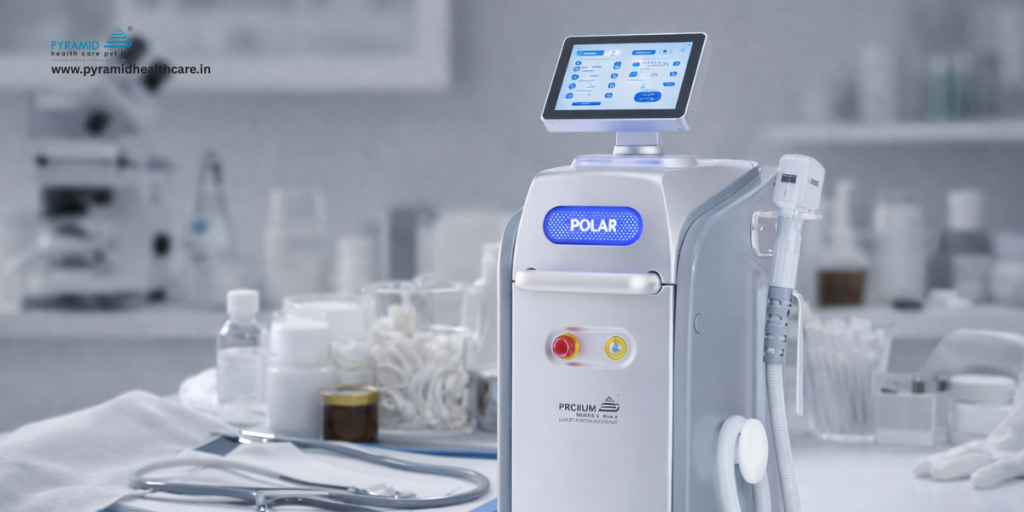
Clinical Perspective on the Polar Premium Platform
For dermatologists seeking a platform aligned with Indian treatment realities, the Polar Premium system has been developed with an emphasis on controlled energy delivery, skin-type-oriented presets, and workflow efficiency. Rather than focusing solely on peak power metrics, its design prioritises reproducibility—an important factor when performing serial low-fluence sessions for melasma or treating PIH-prone patients. The integration of consistent cooling support, parameter customisation, and structured training modules helps reduce operator-dependent variability, which is often the hidden cause of complications in darker skin. From a practice standpoint, its multi-indication capability allows clinicians to manage pigmentation, acne scars, rejuvenation, and tattoo removal on a single platform, improving device utilisation while maintaining safety protocols suited to Fitzpatrick IV–VI patients.
Common Pitfalls When Selecting a Pico Platform
Dermatologists frequently encounter issues when decisions are based on marketing claims rather than clinical parameters:
- Choosing devices with high peak power but poor energy stability
- Over-reliance on 532 nm in melasma-prone patients
- Inadequate cooling leading to PIH
- Lack of certification and calibration support
- Limited service infrastructure in India
Avoiding these mistakes significantly improves patient outcomes and device longevity.
A Practical Pre-Purchase Checklist
Before investing in a Pico Laser Machine, confirm:
- Dual or triple wavelength capability
- True picosecond pulse technology
- Reliable cooling system
- Fine fluence and spot size control
- Fractional handpiece availability
- FDA/CE/ISO certifications
- Strong Indian service and training support
Final Thoughts
The Best Pico Laser Machine for Indian skin is not defined by brand visibility or peak power claims—it is defined by safety engineering, wavelength versatility, cooling efficiency, and reproducible clinical outcomes.
When these elements come together, dermatologists can confidently treat melanin-rich skin with:
- Lower PIH risk
- Better melasma control
- Improved scar outcomes
- High patient satisfaction
In today’s pigment-heavy aesthetic landscape, a thoughtfully chosen picosecond platform becomes more than a device—it becomes a cornerstone of safe, long-term dermatologic care for Indian patients.
Choosing the right picosecond platform can transform your pigmentation and acne scar outcomes while protecting melanin-rich skin from complications. If you’re evaluating the Best Pico Laser Machine for your clinic, focus on systems that combine wavelength versatility, precise energy control, and dependable service support tailored to Indian practice needs.
To explore a clinically aligned solution designed for Fitzpatrick IV–VI workflows, protocol-driven treatments, and multi-indication use, connect with the Pyramid Healthcare team for detailed specifications, hands-on demonstrations, and dermatologist training support. A well-chosen Pico Laser Machine is not just an investment in technology—it’s an investment in safer results, higher patient satisfaction, and long-term practice growth.


 2025 All Rights Reserved, Pyramid Healthcare.