

Laser vs RF Moles Removal Machine: Which Is Better for Indian Skin Types?
Moles, skin tags, and benign lesions are common concerns for many individuals seeking clearer, more even-toned skin. With advancements in aesthetic technology, non-surgical mole removal has become safer, faster, and more precise than ever before. Among the most widely used solutions today are the Laser Moles Removal Machine and the RF Moles Removal Machine.
For Indian skin types—typically richer in melanin—the choice of technology is particularly important. Selecting the right method not only impacts results but also determines healing time, scarring risk, and post-treatment pigmentation. This article explores the differences between laser and RF mole removal, helping practitioners and patients make informed decisions.
Understanding Indian Skin: A Critical Factor in Mole Removal
Indian skin generally falls within Fitzpatrick skin types IV to VI, meaning it has higher melanin levels. While this provides natural protection against UV damage, it also makes the skin more susceptible to post-procedure issues such as hyperpigmentation or uneven healing if the wrong technology or settings are used.
This is why modern Moles Removal Machines must offer precision, adjustable parameters, and strong safety features—especially when treating darker skin tones.
Laser Moles Removal Machine: Advanced Precision and Minimal Downtime
A laser mole removal machine uses concentrated light energy to target pigmented mole cells. The laser selectively breaks down the melanin or tissue within the mole while preserving the surrounding skin. Because of this precision, laser technology is widely preferred for cosmetic areas such as the face and neck.
Key Advantages of Laser Mole Removal
- Non-invasive treatment with no cutting or sutures
- High precision, reducing damage to surrounding tissue
- Minimal bleeding and lower scarring risk
- Faster healing and minimal downtime
- Ideal for flat or pigmented moles
When performed by trained professionals, laser mole removal delivers excellent cosmetic outcomes. However, for Indian skin, it is essential that the laser device allows controlled energy delivery to minimize pigmentation risks.
RF Moles Removal Machine: Reliable Solution for Raised Lesions
An RF Moles Removal Machine works on radiofrequency energy rather than light. It generates controlled heat to ablate or cut tissue, making it especially effective for raised, fibrous, or non-pigmented moles and skin tags.
Key Advantages of RF Mole Removal
- Highly effective for raised or protruding moles
- Less dependence on pigment absorption
- Minimal bleeding due to tissue coagulation
- Suitable for all skin tones, including darker skin
- Excellent control for small, localized lesions
RF technology is often chosen when the mole is elevated or when laser treatment may not be ideal. Healing may take slightly longer than laser procedures, but results are typically consistent and safe when proper aftercare is followed.
Laser vs RF: Which Technology Is Better for Indian Skin?
There is no one-size-fits-all answer. Both technologies are effective, but their suitability depends on individual cases.
Laser Mole Removal Machine is ideal when:
- The mole is flat or deeply pigmented
- Cosmetic outcome is the top priority
- Minimal downtime is preferred
RF Moles Removal Machine is ideal when:
- The mole is raised or skin-colored
- Pigment-independent treatment is required
- Controlled tissue removal is necessary
In many advanced clinics, dermatologists may use both technologies depending on the type, size, and location of the mole.
Laser vs RF Moles Removal Machine: Comparison Table
| Feature | Laser Moles Removal Machine | RF Moles Removal Machine |
|---|---|---|
| Technology Used | Uses focused laser light energy to target pigmented mole tissue | Uses radiofrequency energy to cut or ablate tissue through controlled heat |
| Best Suited For | Flat, pigmented moles and cosmetic facial lesions | Raised, fibrous, or skin-colored moles and skin tags |
| Suitability for Indian Skin Types | Safe for Indian skin when parameters are carefully adjusted | Highly suitable for all Indian skin tones due to pigment-independent action |
| Precision Level | Very high precision with minimal impact on surrounding skin | High precision with excellent control over tissue depth |
| Risk of Pigmentation | Low when performed correctly; requires experienced handling on darker skin | Very low risk as treatment does not rely on melanin absorption |
| Scarring Risk | Minimal scarring in most cases | Minimal scarring when proper technique is used |
| Bleeding During Procedure | Minimal to none | Minimal due to natural coagulation effect |
| Pain & Comfort | Mild discomfort, often reduced with cooling systems | Mild to moderate discomfort depending on lesion size |
| Healing Time | Faster recovery, usually within a few days | Slightly longer recovery, typically 5–10 days |
| Downtime | Very minimal; patients resume normal activities quickly | Short downtime; mild scabbing may occur |
| Cosmetic Outcome | Excellent cosmetic results, especially on face and neck | Very good cosmetic results for raised lesions |
| Operator Skill Requirement | Requires trained professionals for safe use on melanin-rich skin | Requires clinical expertise but less dependent on skin pigment |
| Common Clinical Use | Dermatology and aesthetic clinics for cosmetic mole removal | Dermatology clinics for raised lesion and skin tag removal |
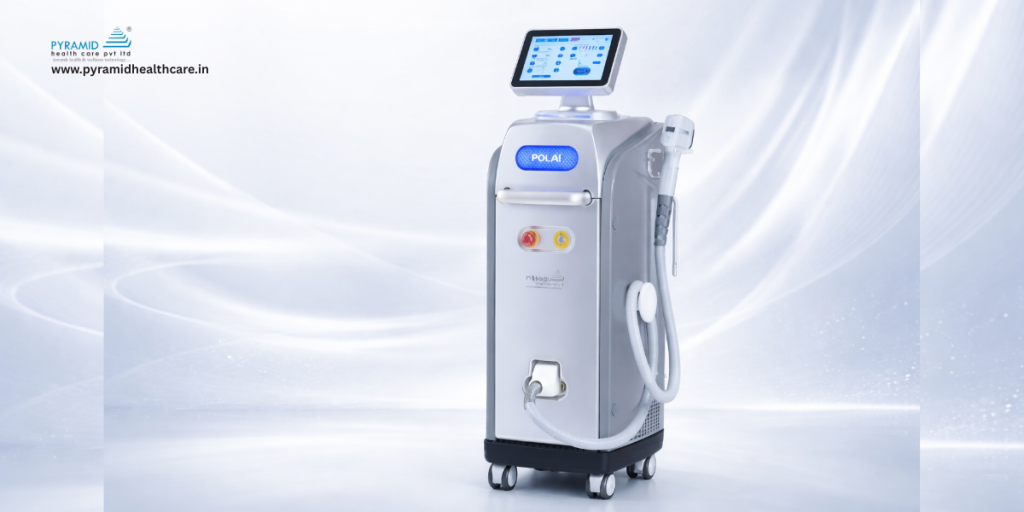
Explaining the POLAR Premium Laser Machine
The POLAR Premium Laser Machine by Pyramid Healthcare represents the new generation of advanced laser platforms designed for Indian conditions and diverse skin tones. While widely recognized for laser hair reduction, its core technology highlights what modern laser systems offer in terms of safety, power, and adaptability.
Key Features of the POLAR Premium Laser System
- Advanced laser technology with optimized wavelength delivery
- Adjustable parameters suitable for multiple Indian skin tones
- Integrated cooling mechanism to enhance patient comfort
- High precision for controlled energy application
- Built to meet modern aesthetic clinic standards
Machines like POLAR Premium demonstrate how advanced laser engineering can safely work with melanin-rich skin when operated by skilled professionals. Such features are essential when adapting laser systems for delicate procedures like mole removal.
Aftercare and Recovery Expectations
Regardless of whether laser or RF technology is used, post-treatment care plays a vital role in outcomes:
- Mild redness or scabbing is normal for a few days
- Sun protection is essential to prevent pigmentation
- Healing typically completes within one to two weeks
- Dermatologist-recommended topical care supports smooth recovery
Proper aftercare ensures optimal cosmetic results and minimizes complications.
Conclusion
Both Laser Moles Removal Machines and RF Moles Removal Machines are proven, effective technologies when used appropriately. For Indian skin types, success depends less on choosing one technology over the other and more on accurate assessment, correct machine settings, and professional expertise.
Laser technology offers superior precision and cosmetic finesse, while RF provides dependable control for raised lesions. When paired with advanced systems like POLAR Premium and handled by experienced practitioners, both approaches can deliver safe, aesthetically pleasing results.
For clinics and patients alike, the key lies in personalized treatment—not just the machine, but how it is used.
Ready to choose the right mole removal solution for your clinic or practice?
Explore advanced Moles Removal Machines designed for Indian skin types and deliver safe, precise, and consistent results. Partner with trusted technology that enhances patient confidence and clinical outcomes.


 2025 All Rights Reserved, Pyramid Healthcare.