

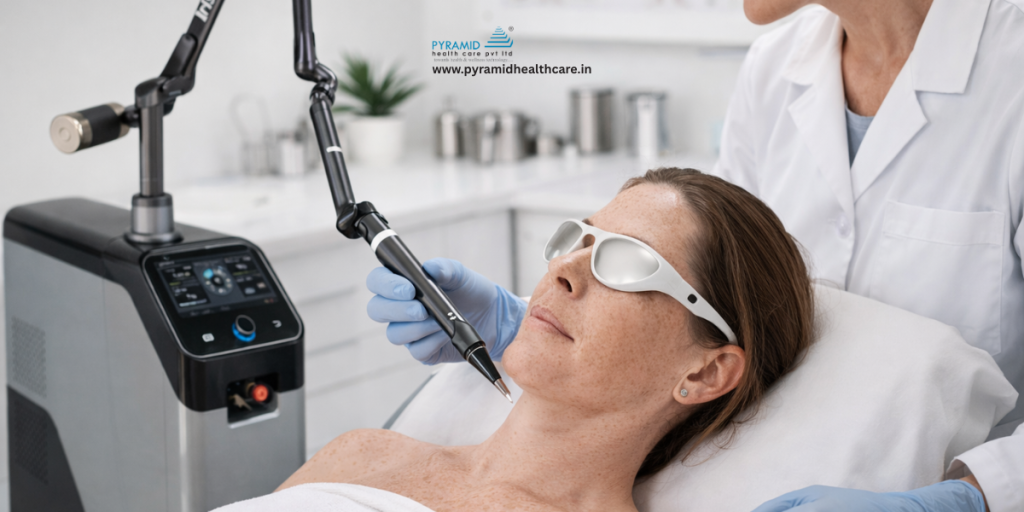
Q Switch Laser Machine for Tattoo Removal: Technology, Results & ROI Explained
Tattoo removal is no longer a niche service—it has become one of the most requested procedures in dermatology and aesthetic practice. As tattoo trends grow, so does tattoo regret, driving consistent demand for safe and effective removal solutions. For clinics looking to enter or expand in this segment, the Q Switch Laser Machine for Tattoo Removal remains one of the most practical, profitable, and clinically proven technologies available today.
This article breaks down the science, compares it with picosecond devices, and explains how clinics can achieve strong results and faster return on investment using cost-effective Indian systems.
How Q-Switched Laser Technology Actually Works
A Q Switch Laser Machine uses ultra-short pulses of high-energy light in the nanosecond domain. These pulses are delivered so quickly that they create a photoacoustic effect rather than a purely thermal one.
In simple terms:
- The laser targets tattoo pigment using specific wavelengths
- Ink particles absorb the energy and shatter into microscopic fragments
- The body’s lymphatic system gradually clears these particles
The most commonly used wavelengths are:
- 1064 nm – ideal for black, blue, and deep dermal pigments
- 532 nm – effective for red, orange, and some lighter colours
Because the pulse duration is shorter than the skin’s thermal relaxation time, the surrounding tissue remains largely unaffected. This makes Q-switched systems safe for Indian skin types, where post-inflammatory pigmentation is a major concern.
Real-World Results: What Practitioners Can Expect
With proper protocols, Q-switched tattoo removal delivers predictable and progressive fading.
Typical clinical outcomes include:
- Visible lightning after the first or second session
- 60–90% clearance in 6–10 sessions for most black tattoos
- Longer timelines for multicolour or professionally layered ink
- Minimal downtime—temporary frosting, mild erythema, and short healing phases
Beyond tattoo removal, the same device can be used for:
- Carbon laser peel
- Melasma and pigmentation management
- Skin toning and rejuvenation
This multi-indication capability significantly improves device utilisation and revenue per patient.
Q-Switched vs Picosecond: Clinical Reality vs Marketing Hype
Picosecond lasers are often positioned as the “next generation,” mainly due to their shorter pulse duration. While they can break pigment into even finer particles, the practical difference in outcomes is often case-dependent rather than universally superior.
Key considerations for clinics:
- Picosecond systems require substantially higher capital investment
- Maintenance costs and handpiece replacements are expensive
- Treatment pricing must be higher to recover costs
- The number of sessions may reduce slightly, but not dramatically, for all tattoos
For most black and dark-ink tattoos—the majority in Indian clinics—a Q Switch Laser Machine for Tattoo Removal produces comparable clearance when correct fluence and intervals are used.
From a business standpoint, Q-switched platforms often achieve faster break-even and higher per-treatment margins.
ROI: Why Q-Switched Systems Make Financial Sense
Tattoo removal is a repeat-session treatment, which makes it ideal for building predictable revenue.
A well-positioned clinic can benefit from:
- Low consumable costs per session
- High patient retention across multiple sittings
- Cross-selling of pigmentation and carbon peel treatments
- Package pricing for full tattoo clearance
Because the acquisition cost of a Q-switched system is significantly lower than that of a picosecond device, most clinics recover their investment within 6 to 9 months, depending on patient volume and pricing strategy.
Competing with Premium Global Brands
International manufacturers like Alma Lasers and Lumenis dominate the premium segment, but their systems come with:
- High import duties
- Costly annual maintenance contracts
- Expensive replacement parts
Modern Indian-engineered platforms now offer:
- Stable energy output
- Adequate peak power for tattoo fragmentation
- Dual wavelengths for multi-colour treatment
- Local service support and faster downtime resolution
This allows clinics to offer competitive pricing while maintaining strong margins, an essential advantage in price-sensitive markets.
A Practical Choice for Clinics: Iris Q-Switch Platform
For clinics seeking a balance between performance, safety, and profitability, the Iris Q Switch Laser Machine stands out as a practical and scalable solution. It delivers consistent 1064 nm and 532 nm wavelengths for effective clearance of black, blue, red, and mixed-colour tattoos, ensuring reliable results across a wide range of patient profiles. Its high peak power enables efficient pigment fragmentation, reducing treatment fatigue for both practitioner and patient. The intuitive interface allows precise control over fluence, spot size, and repetition rate, making it suitable for beginners as well as experienced laser operators. Beyond tattoo removal, Iris supports carbon peel and pigmentation treatments, helping clinics maximise device utilisation and create multiple revenue streams. With the advantages of Indian manufacturing—lower maintenance costs, accessible technical support, and faster service turnaround—it enables clinics to compete with high-cost imported systems while achieving quicker ROI and sustainable growth.
Treatment Protocols That Improve Outcomes
Clinical success depends not just on the machine, but on technique and patient management.
Best practices include:
- Performing test spots for darker skin types
- Maintaining 4–6 week intervals between sessions
- Using conservative fluence initially and escalating gradually
- Enforcing strict photoprotection and post-care
Following these protocols minimises complications such as hypopigmentation or textural changes.
Final Takeaway
For dermatology clinics, med-spas, and aesthetic entrepreneurs, the Q Switch Laser Machine for Tattoo Removal remains a smart, future-ready investment. It combines proven clinical efficacy, versatility across multiple indications, and a business model that supports faster cost recovery.
While picosecond technology has its place in high-end practices, Q-switched systems continue to deliver the best balance of results, affordability, and scalability, especially in markets where treatment pricing and ROI timelines matter.
With reliable Indian platforms like Iris, clinics can confidently expand their laser portfolio, attract a broader patient base, and build a profitable tattoo removal service without the financial burden of premium imports.
Ready to add profitable tattoo removal services to your clinic?
Discover how the Iris Q Switch Laser Machine can help you deliver proven results, attract more patients, and achieve faster ROI—without the high cost of imported systems.
Request a demo today and take the next step toward scalable aesthetic growth.


 2025 All Rights Reserved, Pyramid Healthcare.