

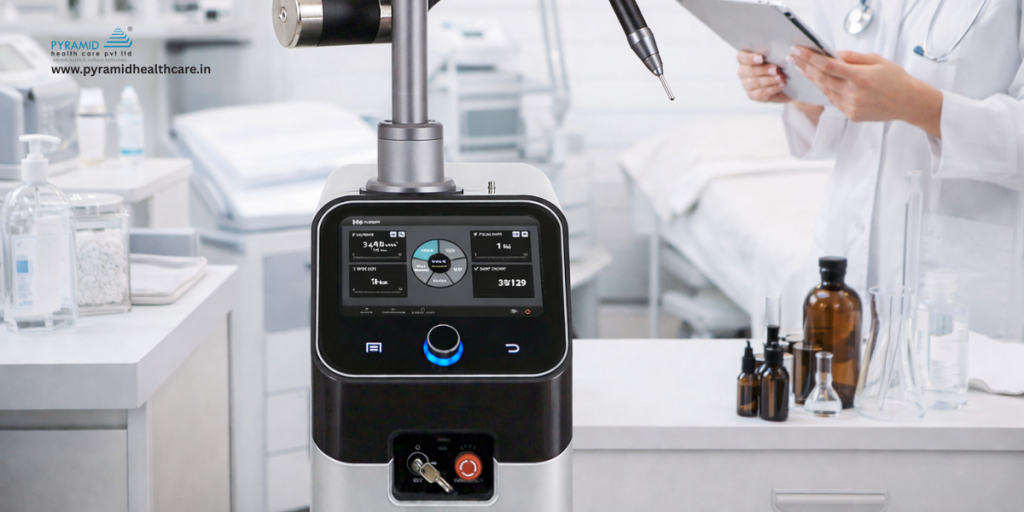
What Determines Q Switched Laser Price? 7 Key Factors Every Indian Clinic Must Evaluate Before Investing
The demand for pigmentation correction, tattoo removal, and laser facials is rising rapidly across Indian aesthetic practices. As a result, more clinics are planning to invest in a Q Switched Laser Price to expand their treatment portfolio and increase monthly revenue.
However, one of the most common questions clinic owners ask is:
Why does the Q Switched Laser price vary so much?
In India, you may find machines priced below ₹1 lakh and others crossing ₹7–8 lakhs. The difference is not just branding—it reflects technology, safety, clinical performance, and long-term business value. Making the right choice requires understanding the factors that truly influence cost and return on investment.
Understanding the Real Q Switched Laser Price in India
A typical Q Switched Laser price range in the Indian market looks like this:
- Entry-level portable units: ₹70,000 – ₹1.5 lakh
- Mid-segment clinic systems: ₹1.5 – ₹3.5 lakh
- Advanced dual-wavelength platforms: ₹4 – ₹8 lakh+
While budget machines may seem attractive for new clinics, they often lack energy stability, service support, and consistent outcomes—leading to higher long-term costs.
The smarter approach is to evaluate value, not just price.
1. Core Machine Quality & Energy Stability
The internal engineering of a Q Switched Laser is the single biggest price determinant.
Two machines may look identical externally, but differences in:
- Laser cavity design
- True fluence delivery
- Pulse duration accuracy
- Cooling technology
directly affect treatment results.
Low-quality systems often show fluctuating energy output. This leads to:
- Inconsistent pigmentation clearance
- Increased risk of post-inflammatory hyperpigmentation (PIH)
- Higher consumable failure
For Indian skin types (Fitzpatrick IV–V), energy stability is critical for safe outcomes. A well-built machine reduces complications and improves patient trust—both essential for repeat business.
2. Wavelength Capability: 1064nm vs 532nm
A professional Q Switched Laser should ideally offer dual wavelengths:
- 1064nm → Deep dermal pigmentation, tattoos, nevus of Ota, carbon peel
- 532nm → Superficial pigmentation, lentigines, red/brown lesions
Single-wavelength devices are cheaper but limit treatment indications. Dual-wavelength platforms cost more, yet they:
✔ Expand your service menu
✔ Improve treatment customisation
✔ Increase per-patient billing potential
For Indian clinics, 1064nm performance is particularly important because it is safer for darker skin tones.
3. Brand Credibility & Clinical Reliability
Brand value in laser devices is not just about marketing—it reflects:
- Optics quality
- Handpiece lifespan
- Calibration accuracy
- Clinical validation
Unknown OEM machines may offer a lower Q Switched Laser price, but they often lack consistent output and proper safety certifications. This can result in:
- Poor results
- Patient dissatisfaction
- Negative word-of-mouth
In aesthetics, reputation is revenue. A reliable device helps build long-term patient confidence.
4. Service Support & Downtime Risk
One of the most overlooked cost factors is after-sales support.
Before purchasing, every clinic should ask:
- Is there a trained service engineer in my city or state?
- What is the average repair turnaround time?
- Are spare parts readily available in India?
A machine that stays non-functional for two weeks can result in significant revenue loss, appointment cancellations, and patient drop-off.
Strong local service support often justifies a slightly higher upfront investment.
5. Training, Protocols & Clinical Guidance
Many suppliers provide only installation, while others offer:
- Hands-on treatment training
- Indian skin-specific protocols
- Parameter guidance for different indications
- Marketing and case-building support
Proper training leads to:
✔ Better clinical outcomes
✔ Faster patient conversion
✔ Higher treatment confidence
Clinics with structured training programs typically achieve break-even faster because they can start offering full treatment menus immediately.
6. Technology Format: Standalone vs Multi-Platform
Standalone Q Switched Laser systems are more affordable and ideal for clinics focused mainly on pigmentation and tattoo removal.
Multi-technology platforms (Q Switch combined with IPL/SHR or future upgrade options) cost more but provide:
- Space efficiency
- Broader treatment offerings
- Higher patient retention
For new aesthetic setups, a multi-functional platform can accelerate revenue growth.
7. Warranty, Consumables & 5-Year Ownership Cost
The real Q Switched Laser price is the total cost over five years—not just the purchase amount.
Key elements to evaluate:
- Warranty duration
- Flash lamp life (number of shots)
- Handpiece replacement cost
- AMC pricing after warranty
A low-cost machine with frequent consumable replacement may become more expensive than a premium system within the first year.
ROI Potential for Indian Clinics
A standard laser carbon peel or pigmentation session typically ranges between ₹2,000 and ₹4,000.
With a conservative estimate:
- 3 patients per day
- 20 working days per month
Monthly revenue potential: ₹1.2 – ₹2.4 lakh
This means a well-utilized Q Switched Laser can achieve break-even within 3 to 6 months, making it one of the fastest ROI-generating devices in aesthetic practice.
A Practical Choice for Indian Clinics: IRIS Bluetoning Q Switched Laser
For clinics seeking a dependable balance between performance, safety, and affordability, the IRIS Q Switched Laser is a thoughtfully designed solution for the Indian aesthetic market. It offers stable dual wavelengths (1064nm and 532nm), allowing practitioners to treat a wide range of indications—from melasma and freckles to tattoo removal and carbon peel—across diverse Indian skin types. What makes this system particularly relevant for clinic owners is its consistent energy delivery, which supports predictable clinical outcomes while minimising the risk of complications such as PIH. The platform is built with a user-friendly interface, enabling smooth workflow even for new laser users, and is backed by structured training and accessible local service support to reduce downtime. From a business standpoint, this combination of clinical versatility, operational reliability, and guided onboarding helps clinics start treatments confidently and scale their laser services faster, improving both patient satisfaction and revenue potential.
Final Thoughts
Choosing the right Q Switched Laser is not about finding the lowest price—it is about selecting a system that delivers:
- Consistent clinical results
- Strong service support
- Safe treatment for Indian skin
- Long-term profitability
A well-informed investment transforms a laser device from a cost centre into a high-yield revenue generator. Clinics that evaluate technology, training, and total ownership cost—rather than just the Q Switched Laser price—are the ones that build sustainable, successful aesthetic practices.
Ready to upgrade your clinic with a high-performance Q Switched Laser? Discover how the IRIS system can help you deliver safer treatments, faster results, and higher monthly revenue with dependable service support across India. Book a demo today and start your laser practice with confidence.

 2025 All Rights Reserved, Pyramid Healthcare.